


India Potassium Permanganate Exporters
India Potassium Permanganate Exporters
Potassium permanganate (KMnO4) is a powerful oxidising agent with wide-ranging industrial applications,0 from water treatment and chemical synthesis to pharmaceuticals and aquaculture. India is one of the world's leading producers and exporters of potassium permanganate, with a well-established manufacturing base concentrated in the industrial states of Gujarat and Maharashtra. Turkey, which imported potassium permanganate under GTIP code 284161 in 2016, sourced the product from four countries: China, India, the United States, and Germany, with India representing a significant and cost-competitive supply source. This directory presents seven Indian potassium permanganate exporters and manufacturers, complete with full contact details, addresses, and company profiles, enabling international buyers to establish direct sourcing relationships with Indian suppliers.
Key Topics: Potassium permanganate exporters India, KMnO4 manufacturers India, GTIP 284161, Organic Industries, Libox Chem, Universal Chemicals, N R Chemicals, Taj Pharmaceuticals, P J Chemicals, Nimraj Chem, India chemical exporters, Turkey KMnO4 imports
- 1. About Potassium Permanganate (KMnO4)
- 2. Complete Exporter Directory - 7 Indian Companies
- 3. Gujarat-Based Exporters
- 4. Maharashtra-Based Exporters
- 5. Madhya Pradesh-Based Exporters
- 6. Potassium Permanganate Applications
- 7. HS Code 284161 and Trade Classification
- 8. Turkey's KMnO4 Import Sources
- 9. India's Chemical Export Infrastructure
- 10. Frequently Asked Questions
About Potassium Permanganate (KMnO4)
Potassium permanganate is an inorganic compound with the chemical formula KMnO4. It appears as dark purple, almost black, crystalline solid that dissolves in water to produce an intensely purple solution, one of the most distinctive and recognisable colours in all of chemistry. The compound is a powerful oxidising agent, meaning it readily accepts electrons from other substances and is itself reduced in the process. This oxidising property, combined with the compound's stability as a solid, ready solubility in water, and relatively low cost of production, makes potassium permanganate one of the most versatile and widely used chemicals in industrial, environmental, and laboratory applications worldwide.
The global potassium permanganate market is valued at approximately 150-200 million USD annually, with demand driven primarily by water and wastewater treatment, chemical manufacturing, and pharmaceutical synthesis. India and China are the two dominant producing countries, collectively accounting for an estimated 60-70% of global production capacity. Indian manufacturers benefit from access to raw materials (potassium hydroxide and manganese dioxide), established chemical manufacturing infrastructure, competitive labour costs, and favourable export incentives provided by the Indian government. The country's strategic location on major shipping routes connecting Asia to Europe, the Middle East, and Africa also provides logistical advantages for chemical exporters serving international markets.
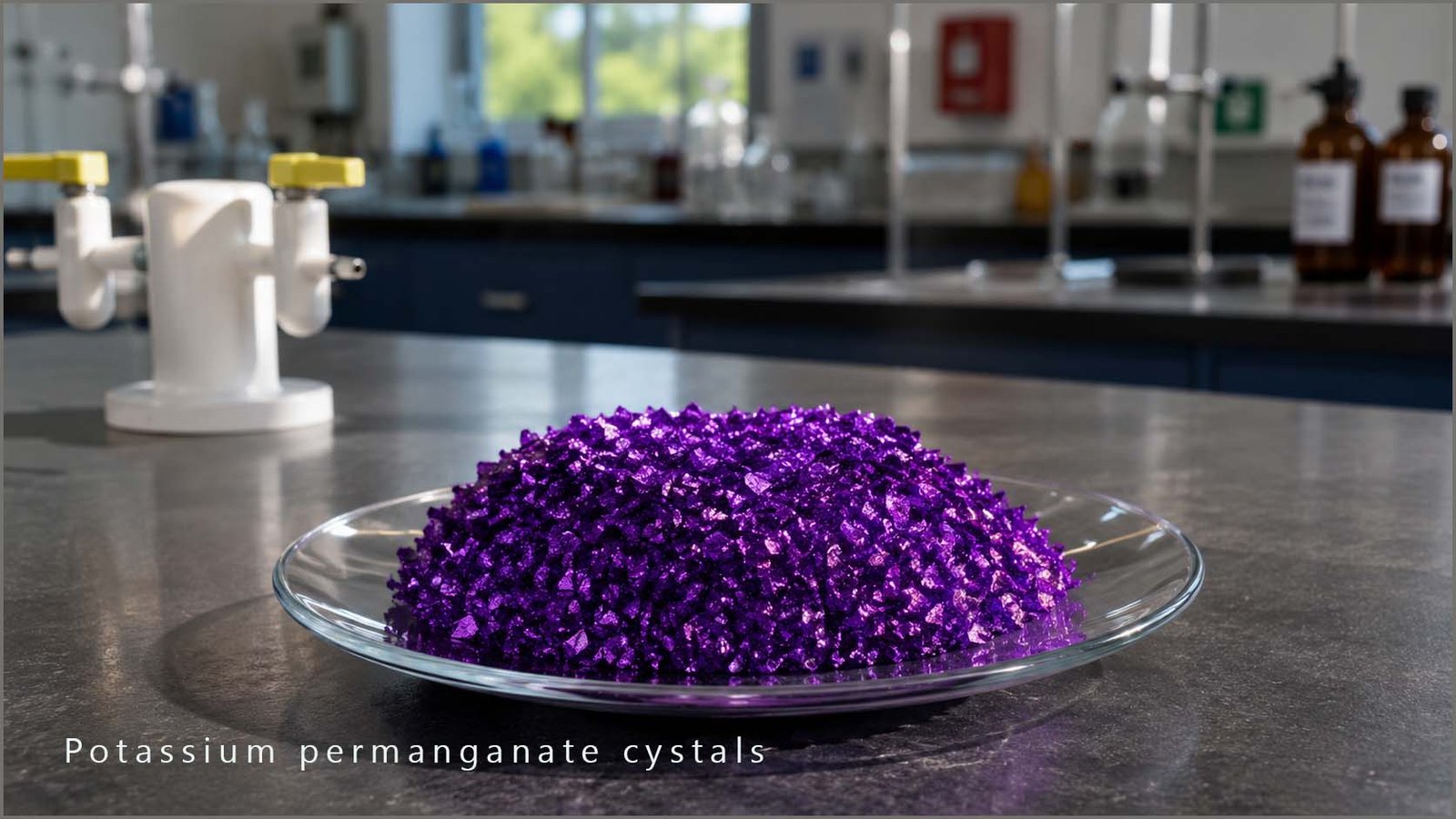
Potassium permanganate (KMnO4) crystals - distinctive dark purple solid that dissolves to form an intensely purple solution
From a regulatory and safety perspective, potassium permanganate is classified as an oxidiser (UN 1490, Class 5.1) under the UN Recommendations on the Transport of Dangerous Goods. This classification requires that the product be packaged, labelled, and transported in accordance with the International Maritime Dangerous Goods (IMDG) Code for sea shipments and the International Air Transport Association (IATA) Dangerous Goods Regulations for air shipments. Indian exporters must ensure compliance with these regulations, as well as the requirements of the Indian Chemical Accidents Rules, the Manufacture, Storage and Import of Hazardous Chemicals Rules, and the National Chemicals Management Profile. For buyers in Turkey and other importing countries, the hazard classification of KMnO4 also triggers specific customs handling, storage, and workplace safety requirements that must be managed throughout the supply chain.
Complete Exporter Directory - 7 Indian Companies
The following table presents all seven Indian potassium permanganate exporters and manufacturers identified through trade data analysis and company registry research. Each company has been verified as an active Indian business entity with involvement in the production or export of potassium permanganate under HS code 284161. The companies are distributed across three Indian states, with the majority located in Gujarat, India's leading chemical manufacturing state, followed by Maharashtra, home to Mumbai's major port and commercial infrastructure.
| No | Company Name | Location | Telephone | Contact / Email |
|---|---|---|---|---|
| 1 | Organic Industries Pvt. Ltd. | Bharuch, Gujarat | ||
| 2 | Libox Chem India Pvt. Ltd. | Mumbai, Maharashtra | +91-22-2346 6060 | sales@liboxchem.com |
| 3 | Universal Chemicals and Industries Pvt. Ltd. | Mumbai, Maharashtra | +91 22 4353 4353 | KAMALESHKUMAR MAHESHWARI |
| 4 | N. R. Chemicals Corporation | Dewas, Madhya Pradesh | +91-7210130487 | Mr. Mohd. Yusuf Khan |
| 5 | Taj Pharmaceuticals Limited (Taj API) | Mumbai, Maharashtra | +91-(0)22-2674 0055 / +91-(0)22-2674 0011 | |
| 6 | P J Chemicals | Vapi, Gujarat | ||
| 7 | Nimraj Chem Agrovet | Anand, Gujarat | +91-9206073597 |
Gujarat-Based Exporters
Gujarat is India's premier chemical manufacturing state, and four of the seven potassium permanganate exporters in this directory are located in the state. This concentration is not coincidental; Gujarat has systematically developed its chemical industry over decades through a combination of proactive industrial policy, world-class infrastructure, and geographic advantages that have made it the preferred location for chemical manufacturers serving both domestic and export markets.
1. Organic Industries Pvt. Ltd.
Organic Industries Pvt. Ltd. is located in the Gujarat8 GIDC (Gujarat Industrial Development Corporation) estate at Dahej, in Bharuch district of Gujarat. The GIDC estate at Dahej is one of India's largest and most modern industrial parks, strategically positioned near the Dahej port on the Gulf of Khambhat (Cambay), which provides direct access to maritime shipping routes. This location gives Organic Industries a significant logistical advantage for chemical exports, with container loading facilities available within close proximity of the manufacturing site. The company's position within the GIDC framework also ensures access to established industrial infrastructure including reliable power supply, water treatment facilities, effluent treatment plants, and industrial security services. Organic Industries operates under the umbrella of the Organic Group, as indicated by its website domain (organicgroup.co.in), suggesting a broader corporate structure with potential sister companies in related chemical sectors.
Address: S/163, GIDC, Dahej, Tal. Vaghra, Dist. Bharuch - 392130, Gujarat, India
Website: www.organicgroup.co.in
2. P J Chemicals
P J Chemicals is based in Vapi, another major GIDC industrial estate in Gujarat's Valsad district, close to the Maharashtra border. Vapi is part of the Vapi-Valsad-Daman industrial corridor, one of the densest concentrations of chemical and pharmaceutical manufacturing in India, with over 1,500 industrial units operating in the area. The proximity to Daman port and the excellent road and rail connectivity to Mumbai (approximately 180 km) provide P J Chemicals with efficient access to both domestic and export logistics networks. The company's location at GIDC Char Rasta, a well-established industrial junction, places it within a mature industrial ecosystem with established supplier networks, maintenance services, and waste management infrastructure critical for chemical manufacturing operations.
Address: 214, 2nd Floor, Krishna Complex, N.H. 8, GIDC Char Rasta, Vapi - 396195, Gujarat, India
Website: www.pjchemicals.com
3. Nimraj Chem Agrovet
Nimraj Chem Agrovet is located in Anand, in the Charotar region of central Gujarat. The company's name, combining "Chem" and "Agrovet," indicates that it operates at the intersection of the chemical and agricultural-veterinary sectors, producing chemical products including potassium permanganate that serve agricultural and veterinary applications in addition to industrial uses. This dual focus is common among Indian chemical manufacturers, many of whom produce a range of industrial chemicals alongside agrochemicals and veterinary products for the domestic agricultural market. Anand's GIDC estate, while smaller than the mega-industrial parks at Dahej and Vapi, provides established industrial infrastructure in one of Gujarat's most agriculturally productive districts, positioning Nimraj Chem Agrovet to serve both industrial and agricultural customer segments.
Address: Plot No. 209, G.I.D.C, Opposite G.E.B. Mogri Road, At. V.U. Nagar, Anand - 388121, Gujarat, India
Phone: +91-9206073597 | Fax: 91-2692-236821
Maharashtra-Based Exporters
Maharashtra, India's most industrialised state and home to Mumbai, the country's commercial capital and largest port, hosts three of the seven potassium permanganate exporters in this directory. Mumbai's role as India's primary gateway for international trade, with the Jawaharlal Nehru Port (JNPT) handling approximately 50% of India's containerised cargo, provides Maharashtra-based chemical exporters with unparalleled access to global shipping networks.
4. Libox Chem India Pvt. Ltd.
Libox Chem India Pvt. Ltd. is based in South Mumbai, in the Masjid Bunder area near Mumbai's historic commercial district. The company's office in the Prem Jivan Building on Kazi Sayed Street places it in the heart of Mumbai's chemical trading district, where many of India's chemical importers, exporters, and traders maintain their commercial offices. This location provides excellent access to the Mumbai chemical market, the Mumbai Port Trust, and JNPT for export shipments. The company's provision of both telephone (+91-22-2346 6060) and tele-fax (+91-22-2346 4775) numbers, along with a dedicated sales email (sales@liboxchem.com), indicates a well-organised commercial operation with dedicated sales and customer service functions.
Address: Prem Jivan Building, Office No.5, 2nd Floor, 87, Kazi Sayed Street, Masjid (West), Mumbai - 400003, India
Phone: +91-22-2346 6060 | Fax: +91-22-2346 4775 | Email: sales@liboxchem.com
Website: www.liboxchem.com
5. Universal Chemicals and Industries Pvt. Ltd.
Universal Chemicals and Industries Pvt. Ltd. is headquartered at Nariman Point, Mumbai's prestigious business district often described as "India's Manhattan." The company's office in the Raheja Centre, one of Nariman Point's landmark commercial towers, reflects its standing as an established and substantial business entity. The identified contact person, KamaleshKumar Maheshwari, serves as a key point of contact for commercial enquiries. Nariman Point's location at the southern tip of Mumbai's peninsula provides proximity to both the Mumbai Port and the corporate offices of major shipping lines, banks, and trading houses, facilitating the financial and logistical transactions that underpin internationalA international chemical trade.
Address: 507, Raheja Centre, 214, Nariman Point, Mumbai, Maharashtra 400024, India
Phone: +91 22 4353 4353 | Contact: KamaleshKumar Maheshwari
6. Taj Pharmaceuticals Limited (Taj API)
Taj Pharmaceuticals Limited, operating through its Taj API division, is a Mumbai-based pharmaceutical and chemical manufacturing company located in the Oshiwara Industrial Estate in Goregaon (West). The company's classification as a pharmaceutical manufacturer is significant in the context of potassium permanganate, as KMnO4 is an important reagent and intermediate in pharmaceutical synthesis, particularly in the production of certain antibiotics, vitamins, and organic synthesis reactions. Taj Pharmaceuticals' involvement in KMnO4 production likely reflects a vertically integrated approach where the company produces potassium permanganate both for its own pharmaceutical manufacturing requirements and for external sale to industrial customers. The company's dual phone lines (+91-22-2674 0055 and 2674 0011) and dedicated fax line suggest a substantial operation with multiple departments and significant call volumes.
Address: B/134, Oshiwara Industrial Centre, Oshiwara Bus Depot, Link Road, Goregaon (West), Mumbai - 400104, India
Phone: +91-(0)22-2674 0055 / +91-(0)22-2674 0011 | Fax: +91-(0)22-2674 0101
Website: www.tajapi.com
Madhya Pradesh-Based Exporters
7. N. R. Chemicals Corporation
N. R. Chemicals Corporation is located in Dewas, an industrial city in Madhya Pradesh, central India. Dewas has developed as a significant industrial centre, particularly for chemical and pharmaceutical manufacturing, benefiting from the state government's industrial promotion policies and its strategic location on the Delhi-Mumbai industrial corridor. The city's proximity to Indore (approximately 40 km), Madhya Pradesh's largest city and commercial hub, provides access to established logistics networks, financial services, and professional support infrastructure. The identified contact person, Mr. Mohd. Yusuf Khan, and the provision of both landline and mobile numbers (+91-7210130487) indicate that N. R. Chemicals maintains an accessible and responsive commercial operation. The company's location in Alkapuri, a developed residential and commercial area of Dewas, suggests an established business with permanent premises rather than a newer or more transient operation.
Address: No. 253, Alkapuri, Dewas - 455001, Madhya Pradesh, India
Phone: +91-7210130487 | Fax: 91-7272-408686/409697 | Contact: Mr. Mohd. Yusuf Khan
Website: www.nrchemicals.co.in
Potassium Permanganate Applications
Potassium permanganate's powerful oxidising properties make it indispensable across a remarkably diverse range of industrial and environmental applications. Understanding these applications is essential for appreciating the market dynamics that drive demand for Indian KMnO4 exports and the factors that influence pricing, quality specifications, and supply chain requirements.
Water and Wastewater Treatment: This is the single largest application for potassium permanganate globally. KMnO4 is used for the oxidation of iron, manganese, and hydrogen sulphide in drinking water treatment, the control of taste and odour compounds, the removal of organic contaminants including phenols and certain pesticides, and as a pre-oxidant ahead of conventional water treatment processes. In wastewater treatment, KMnO4 is employed for the oxidation of toxic and refractory organic compounds, cyanide destruction, and odour control. The global push for improved water quality and the expansion of water treatment infrastructure in developing countries continue to drive strong demand growth for this application.
Chemical Synthesis: In organic chemistry, potassium permanganate is a versatile oxidising agent used in the synthesis of a wide range of chemical products. Key reactions include the oxidation of alkenes to diols (hydroxylation), the oxidative cleavage of carbon-carbon double bonds to produce carbonyl compounds, the oxidation of primary alcohols to carboxylic acids, and the oxidation of arenes (aromatic hydrocarbons). These reactions are fundamental to the production of fine chemicals, pharmaceuticals, agrochemicals, and specialty organic compounds, making KMnO4 an essential reagent in the chemical manufacturing toolkit.
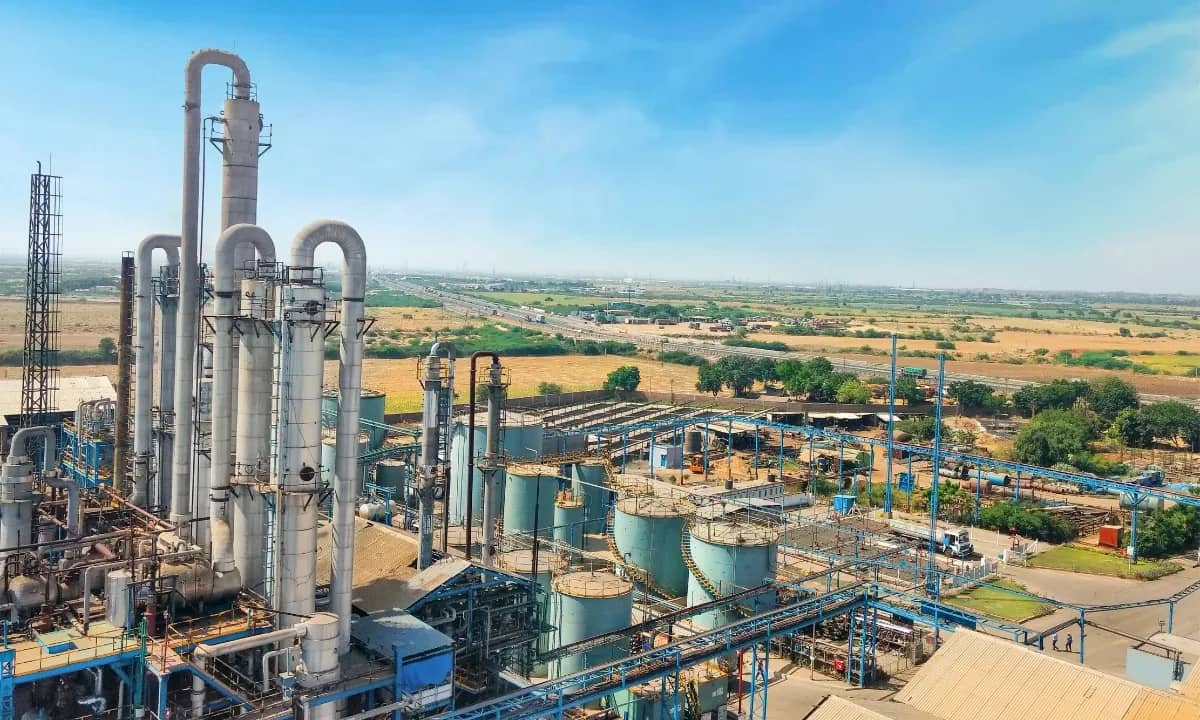
Indian chemical manufacturing facility - representative of the industrial infrastructure supporting KMnO4 production for export
Pharmaceutical Industry: Beyond its use as a laboratory reagent in drug synthesis, potassium permanganate has direct pharmaceutical applications. It is used in the preparation of potassium permanganate solution (typically 1:4,000 to 1:10,000 dilution) for topical antiseptic and fungicidal treatment of skin conditions including athlete's foot, impetigo, and pemphigus. KMnO4 solutions are also used in wound care, particularly for wet dressings in the treatment of ulcerative conditions and as an astringent in dermatological practice. Taj Pharmaceuticals' involvement in KMnO4 production reflects this connection between chemical manufacturing and pharmaceutical applications.
Aquaculture and Fish Farming: Potassium permanganate is widely used in aquaculture for the treatment of bacterial and parasitic infections in fish, including columnaris disease, gill disease, and external protozoan infections. Treatment protocols typically involve bath treatments at concentrations of 2-10 mg/L, with KMnO4 acting as both an antimicrobial agent and an oxidising agent that improves water quality by oxidising organic matter. India's large and growing aquaculture industry provides significant domestic demand for KMnO4, and the expertise gained in serving this market translates into competitive export capabilities for aquaculture-grade product.
HS Code 284161 and Trade Classification
In the Harmonized System (HS) of commodity classification, potassium permanganate is classified under heading 2841, which covers "Salts of oxometallic or perometallic acids." Within this heading, subheading 2841.61 specifically covers "Potassium permanganate." This classification is consistent across all countries that use the Harmonized System, including India (which uses the Indian Trade Classification based on HS, or ITC-HS), Turkey (which uses the GTIP, or Gurmrk Tarife Intibak Pozisyonu, aligned with HS), and all EU member states.
For international trade purposes, the first six digits of the HS code (284161) are harmonised globally, meaning that potassium permanganate is classified under this code regardless of the trading country. Turkey's specific designation of GTIP 284161 aligns with this international standard. Indian exporters must declare their shipments under the corresponding Indian customs tariff subheading, while Turkish importers classify the same goods under GTIP 284161 on the importing side. This harmonisation ensures consistent trade statistics and facilitates the tracking of global KMnO4 trade flows between exporting and importing countries.
For exports from India, potassium permanganate falls under the "Restricted" category of India's Foreign Trade Policy, meaning that exporters must obtain an export licence from the Directorate General of Foreign Trade (DGFT) before shipping the product overseas. This licensing requirement is imposed because KMnO4 is classified as a chemical with potential dual-use applications (it can be used as a precursor in certain illicit drug manufacturing processes, particularly in the production of cocaine). Exporters such as those listed in this directory must maintain valid export authorisations and ensure that their end-use certificates and export documentation are in order before shipping to international destinations including Turkey.
Turkey's KMnO4 Import Sources
According to Turkish trade data for 2016, Turkey imported potassium permanganate (GTIP 284161) from four source countries: China, India, the United States, and Germany. This diverse sourcing pattern reflects Turkey's strategic approach to ensuring supply security for industrial chemicals, avoiding over-reliance on any single supplying country, and accessing competitive pricing from different producing regions.
| Source Country | Competitive Advantage | Typical Position |
|---|---|---|
| China | Largest global producer, lowest production costs, highest production capacity | Price-competitive high-volume supplier |
| India | Strong manufacturing base, competitive pricing, established export infrastructure, English-speaking business environment | Cost-effective alternative with reliable quality |
| United States | Advanced manufacturing technology, stringent quality control, regulatory compliance | Premium quality supplier for critical applications |
| Germany | European quality standards, advanced chemical engineering, REACH compliance | Premium grade supplier, EU regulatory advantage |
India's position as a KMnO4 source for Turkey is underpinned by several competitive advantages. First, Indian production costs are significantly lower than those in the United States or Germany, primarily due to lower labour costs, access to domestically produced raw materials, and economies of scale achieved by serving both India's large domestic market and export markets simultaneously. Second, India's chemical industry has achieved substantial quality improvements over the past two decades, with many manufacturers now producing KMnO4 to international pharmacopoeia standards (BP, USP, EP) and obtaining ISO 9001 and ISO 14001 certifications. Third, the India-Turkey bilateral trade relationship benefits from relatively short shipping transit times (approximately 15-20 days from Mumbai to Istanbul or Mersin by sea) compared to shipments from East Asia, and from established commercial networks developed through decades of textile, agricultural, and chemical trade between the two countries.
India's Chemical Export Infrastructure
The ability of Indian potassium permanganate manufacturers to compete effectively in international markets is underpinned by India's extensive chemical export infrastructure, which has been developed over decades of government investment and private sector growth. Understanding this infrastructure provides context for the operational capabilities and logistical advantages of the exporters listed in this directory.
Gujarat, home to four of the seven exporters, has been the flagship of India's chemical industry development. The state accounts for approximately 35-40% of India's total chemical and petrochemical production, with major industrial estates at Dahej, Vapi, Ankleshwar, Nadiad, and Panoli providing concentrated manufacturing infrastructure. The Gujarat Industrial Development Corporation (GIDC) has played a pivotal role in developing these estates, providing developed land, industrial sheds, common effluent treatment plants, captive power plants, and industrial security. The state's port infrastructure, including Kandla (now Deendayal Port), Mundra, Dahej, and Hazira, provides multiple export gateways with modern container and bulk chemical handling facilities. The Delhi-Mumbai Industrial Corridor (DMIC) project, of which Gujarat is a key beneficiary, is further enhancing the state's logistics infrastructure with dedicated freight corridors, smart industrial cities, and improved port connectivity.
Maharashtra's chemical export infrastructure is centred on Mumbai and its satellite ports. The Jawaharlal Nehru Port Trust (JNPT), located across the harbour from Mumbai, is India's largest container port and the primary gateway for chemical exports from Maharashtra-based manufacturers. JNPT offers direct container shipping services to all major global ports, including Istanbul, Mersin, and Izmir in Turkey, with transit times of approximately 15-20 days for FCL (Full Container Load) shipments. Mumbai's extensive ecosystem of freight forwarders, customs brokers, inspection agencies, and chemical testing laboratories provides comprehensive support services for exporters navigating the documentation and compliance requirements of international chemical trade.
Frequently Asked Questions
What is potassium permanganate used for?
Potassium permanganate (KMnO4) is primarily used as a powerful oxidising agent across multiple industries. The main applications are: (1) Water and wastewater treatment - oxidation of iron, manganese, and organic contaminants; (2) Chemical synthesis - oxidation reactions in pharmaceutical, fine chemical, and agrochemical production; (3) Pharmaceuticals - topical antiseptic and fungicidal solutions for skin conditions; (4) Aquaculture - treatment of bacterial and parasitic infections in fish; (5) Metal surface treatment - cleaning and etching of metal surfaces; (6) Survival and emergency - water purification in field conditions. Its distinctive purple colour in solution makes it easily identifiable in all applications.
Which Indian companies export potassium permanganate?
The seven Indian potassium permanganate exporters listed in this directory are: (1) Organic Industries Pvt. Ltd. (Bharuch, Gujarat); (2) Libox Chem India Pvt. Ltd. (Mumbai, Maharashtra); (3) Universal Chemicals and Industries Pvt. Ltd. (Mumbai, Maharashtra); (4) N. R. Chemicals Corporation (Dewas, Madhya Pradesh); (5) Taj Pharmaceuticals Limited (Mumbai, Maharashtra); (6) P J Chemicals (Vapi, Gujarat); and (7) Nimraj Chem Agrovet (Anand, Gujarat). Four companies are in Gujarat, three in Maharashtra, and one in Madhya Pradesh.
What is GTIP 284161?
GTIP 284161 is Turkey's customs tariff classification for potassium permanganate, aligned with the international Harmonized System (HS) code 2841.61. The code falls under HS Chapter 28 (Inorganic chemicals), heading 2841 (Salts of oxometallic or perometallic acids), and subheading 2841.61 (Potassium permanganate). This classification is used globally, ensuring consistent trade statistics across countries. Turkey imported KMnO4 under this code from China, India, the USA, and Germany in 2016.
Why is Gujarat the main centre for Indian KMnO4 production?
Gujarat dominates Indian chemical manufacturing for several reasons: (1) Proactive industrial policy - the state government has systematically developed chemical industry infrastructure through GIDC industrial estates; (2) Port infrastructure - multiple major ports (Kandla, Mundra, Dahej, Hazira) provide excellent export access; (3) Raw material access - proximity to petrochemical complexes and chemical raw material suppliers; (4) Established ecosystem - over 1,500 chemical units creating supplier networks and shared infrastructure; (5) Effluent treatment - common treatment plants enable environmental compliance; (6) Power reliability - dedicated power infrastructure for industrial estates. These factors make Gujarat the natural location for chemical manufacturers serving export markets.
Is potassium permanganate a regulated chemical?
Yes, potassium permanganate is subject to several regulatory controls: (1) Transport - classified as UN 1490, Class 5.1 (Oxidiser) under the IMDG Code and IATA Dangerous Goods Regulations; (2) Indian export controls - falls under the "Restricted" category requiring DGFT export licence, as it has potential dual-use applications; (3) REACH (EU) - requires registration under the EU REACH Regulation for imports into the European Union; (4) TSCA (USA) - subject to the US Toxic Substances Control Act; (5) Occupational safety - exposure limits apply in workplace handling (OSHA PEL: 5 mg/m3 ceiling). Exporters and importers must ensure compliance with all applicable regulations in both exporting and importing jurisdictions.
How does India compare to China as a KMnO4 supplier?
India and China are the two dominant global producers, collectively accounting for 60-70% of world capacity. Key comparisons: (1) Price - China typically offers the lowest prices due to larger scale and government support, but India is highly competitive; (2) Quality - both produce to international pharmacopoeia standards, though Indian manufacturers often have more established ISO/BRC certifications; (3) Communication - India's English-speaking business environment facilitates smoother commercial interactions; (4) Shipping - India offers shorter transit times to Middle East and European markets; (5) Regulation - Indian exports are well-documented and comply with international trade regulations; (6) Minimum order - Indian suppliers may offer more flexible MOQs for smaller buyers. Many international buyers diversify between Indian and Chinese sources for supply security.
Yorumlar - Yorum Yaz