


UK Sandwich Panel Companies
UK Sandwich Panel Companies
Sandwich panels, also known as insulated panels or composite panels, are a fundamental building material in modern construction across the United Kingdom. These prefabricated building elements consist of two outer metal skins bonded to an insulated core, creating a lightweight yet structurally efficient product that provides simultaneous thermal insulation, weather protection, and structural support in a single component. The UK sandwich panel market serves a diverse range of sectors including industrial warehousing, cold storage and food processing facilities, commercial buildings, agricultural structures, and increasingly, residential and modular construction. This directory presents the leading sandwich panel companies operating in the UK, including both manufacturers and specialist suppliers, with comprehensive contact details, product ranges, and company profiles.
Key Topics: Sandwich panel UK, insulated panel suppliers Britain, Panel Sell, Isoclad, Kingspan insulated panels, Tata Steel panels, cold room panels UK, PIR PUR panel UK, sandwich panel price UK, facade sandwich panel UK
- 1. About Sandwich Panels
- 2. Featured Company: Panel Sell Ltd
- 3. Featured Company: Isoclad Ltd
- 4. Complete UK Panel Company Directory
- 5. Sandwich Panel Types and Core Materials
- 6. Applications in UK Construction
- 7. UK Building Regulations and Fire Safety
- 8. Sandwich Panel Pricing in the UK
- 9. Frequently Asked Questions
About Sandwich Panels
Sandwich panels are prefabricated construction elements consisting of two thin, stiff outer facings (typically steel or aluminium) bonded to a lightweight, thick insulated core. The result is a composite panel that achieves remarkable structural efficiency: the outer skins provide bending resistance while the core provides shear resistance and thermal insulation, producing a lightweight component with strength and stiffness far exceeding what either material could achieve independently. This engineering principle, analogous to an I-beam, makes sandwich panels one of the most cost-effective building envelope solutions available today.
The insulated core of a sandwich panel is available in several materials, each offering distinct performance characteristics. Polyisocyanurate (PIR) and polyurethane (PUR) foam cores provide the highest thermal insulation values per unit thickness, making them ideal for applications where space is constrained or maximum energy efficiency is required. Mineral wool (rock wool or glass wool) cores offer superior fire resistance and acoustic performance, making them the preferred choice for buildings where fire compartmentation and sound attenuation are critical requirements. Expanded polystyrene (EPS) cores provide a budget-friendly option with moderate thermal performance, typically used in less demanding applications.
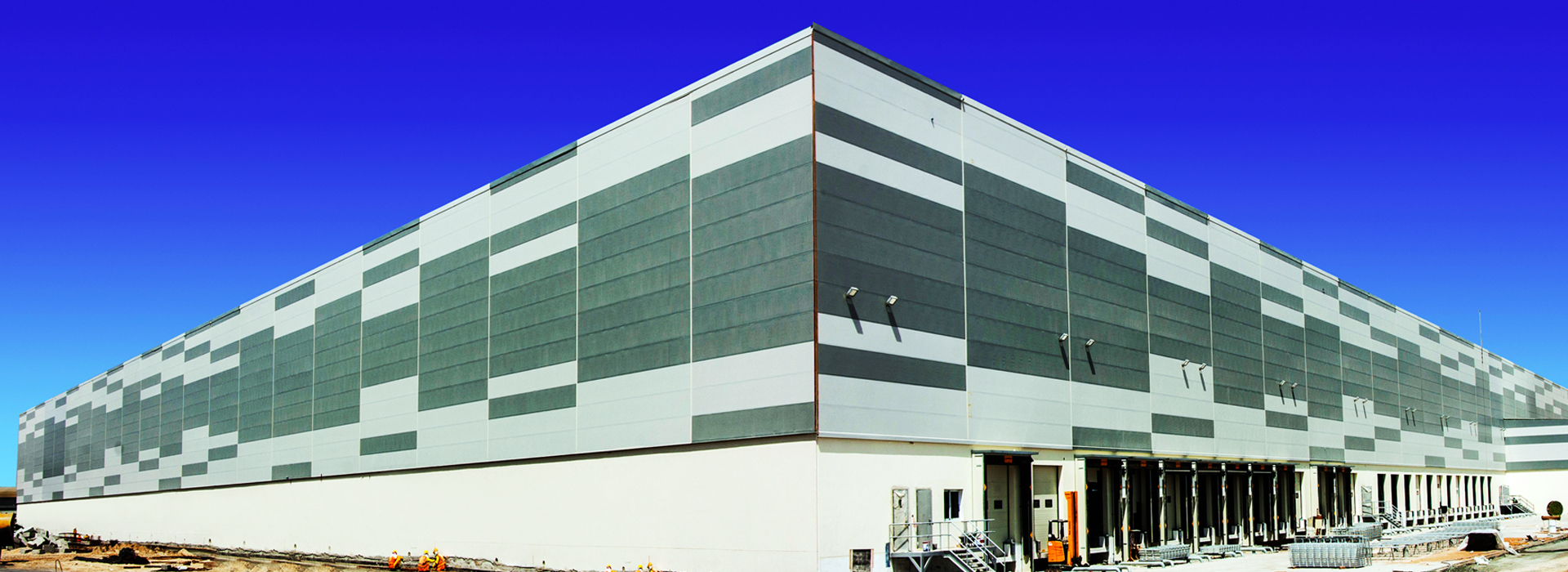
Modern industrial warehouse constructed with insulated sandwich panels - a typical application in the UK construction sector
The UK sandwich panel market has evolved significantly in recent years, driven by several converging factors. Stringent energy efficiency requirements under Part L of the Building Regulations have increased demand for high-performance insulated panels that can achieve low U-values in building envelopes. The growing cold storage and food logistics sector, fuelled by the expansion of online grocery retail and the UK's position as a major food import and distribution hub, has driven strong demand for cold room and freezer panels. Post-Brexit customs infrastructure, including new border control posts and inland border facilities, has created a pipeline of government projects requiring rapid construction of insulated buildings. Additionally, the increasing focus on fire safety following the Grenfell Tower tragedy has led to greater scrutiny of building envelope materials and a shift towards fire-rated panel solutions, particularly mineral wool-cored panels for taller and higher-risk buildings.
Featured Company: Panel Sell Ltd
Panel Sell Ltd is a London-based specialist supplier and distributor of insulated sandwich panels with over 15 years of experience in the construction industry. The company has established itself as a leading one-stop source for sandwich panels and associated building products, serving a diverse client base across the industrial, agricultural, commercial, and private construction sectors. Panel Sell distinguishes itself through its comprehensive product range, competitive pricing, and value-added services including expert technical advice, project development support, and an online panel configurator that allows customers to specify and price custom panel solutions.
| Attribute | Details |
|---|---|
| Company Name | Panel Sell Ltd |
| Website | www.panelsell.co.uk |
| info@panelsell.co.uk | |
| London Office | +44-20-3455 0451 |
| Manchester Office | +44-151-2060-100 |
| Fax | +44-20-3370 7971 |
| Contact Person | Maria Gema PEREZ HERRERA |
| Address | 54-58 Tanner Street, The Brandenburg Suite - Tanner Place, London, SE1 3PH |
| Business Type | Supplier / Distribution / Project Development |
| Experience | 15+ years |
| Languages | English, Danish, German, French, Dutch, Norwegian, Polish, Swedish |
Product Range
Panel Sell offers one of the most comprehensive product ranges among UK sandwich panel suppliers, encompassing both stock articles and tailor-made panel solutions. The company's product portfolio includes the following categories:
- Insulated Roof Panels: PIR and PUR cored panels for industrial, commercial, and agricultural roofing applications. Available in various profiles, thicknesses (typically 40mm to 150mm), and RAL colours, with stock items available for immediate delivery.
- Insulated Wall Panels: Flat and micro-rib profile panels for vertical and horizontal wall cladding applications, providing both thermal insulation and aesthetic facade finishes. Available in a wide range of colours and finishes.
- Insulation Boards: Standalone insulation boards for applications where full sandwich panels are not required, including PIR, PUR, and mineral wool board options.
- Acoustic and Fire Rated Panels: Specialist panels with mineral wool cores providing enhanced fire resistance (up to 4 hours depending on specification) and acoustic performance, suitable for fire compartment walls and noise-sensitive applications.
- Profiled Sheets for Roof and Wall: Single-skin corrugated and trapezoidal profile metal sheets for roofing and wall cladding where insulation is not required or is provided separately.
- Flashings & Profiles: Custom-made flashings, cills, copings, and trims to ensure weathertight joints and aesthetic finishes at panel junctions, corners, and building openings.
- Tek Screws & Fixings: A complete range of self-drilling fasteners, stitchers, and fixing accessories specifically designed for sandwich panel installation.
- Cold Room Doors & Freezer Doors: Hinged and sliding doors for cold storage and freezer rooms, with heated frames and adjustable hinges to ensure reliable operation at sub-zero temperatures.
- Warehouses (New and Used): Complete warehouse solutions including both new-build and reconditioned second-hand warehouses, offering cost-effective options for storage and industrial space requirements.
- Clear Roofing Sheets: Translucent GRP or polycarbonate sheets for natural daylighting in industrial and commercial buildings, designed to integrate with profiled metal roofing systems.
- Residential Containers: Container-based residential and accommodation solutions using insulated panel construction for temporary or permanent housing applications.
Panel Sell's multilingual capabilities, offering services in Danish, German, French, Dutch, Norwegian, Polish, and Swedish in addition to English, reflect the company's international orientation and its ability to serve clients from diverse European backgrounds. This multilingual support is particularly valuable in the UK construction industry, where a significant proportion of the workforce and contractor base originates from continental Europe. The company's dual-location presence in London and Manchester provides geographic coverage of the UK's two largest construction markets, while its online configurator and calculator tools for warehouse and cold store projects enable customers to quickly specify and price their requirements without waiting for manual quotations.
Featured Company: Isoclad Ltd
Isoclad Ltd is a UK-based manufacturer of insulated panels, profiles, and panel joints, operating from its manufacturing facility in North Shields, Tyne & Wear, in the North East of England. Unlike suppliers who distribute products manufactured by others, Isoclad maintains direct control over the manufacturing process, enabling the company to offer bespoke panel specifications, maintain rigorous quality control, and respond quickly to project-specific requirements. This manufacturing capability positions Isoclad as a valuable partner for construction projects that require non-standard panel dimensions, special core materials, or custom colour finishes.
| Attribute | Details |
|---|---|
| Company Name | Isoclad Ltd |
| Website | www.isoclad.co.uk |
| sales@isoclad.co.uk | |
| Telephone | +44 (0) 191 258 5052 |
| Contact Person | Michael Paul McCOLL |
| Address | 10 Alder Road, West Chirton North Industrial Estate, North Shields, Tyne & Wear, NE29 8SD |
| Business Type | Manufacturer |
Product Range
Isoclad's product range, while more focused than Panel Sell's distribution portfolio, covers the essential components required for insulated building envelope construction:
- Insulated Panels: Factory-manufactured sandwich panels with a choice of core materials and outer sheet specifications. Isoclad produces panels for both roof and wall applications, with options for different profiles, thicknesses, and fire performance ratings. As a manufacturer, Isoclad can accommodate non-standard panel lengths and specifications that may not be available from stock-oriented suppliers.
- Profiles: A range of profiled outer sheets and ancillary profiles for roof and wall cladding systems. These profiles are manufactured to match the panel specifications and ensure proper weatherproofing at joints, ridges, eaves, and verges.
- Panel Joints: Jointing systems and components designed to ensure weathertight, thermally efficient, and structurally sound connections between adjacent panels. Proper joint detailing is critical for the performance of insulated panel systems, affecting both the air and water tightness of the building envelope and the continuity of the thermal insulation layer.
Isoclad's location in the North East of England, a region with a strong industrial heritage and a significant concentration of manufacturing, processing, and logistics businesses, positions the company well to serve the industrial construction market in Northern England and Scotland. The West Chirton Industrial Estate provides good access to the A19 and A1 road corridors, facilitating efficient distribution of panels to construction sites across the region. The company's manufacturing presence in the UK also means that projects specifying Isoclad panels can benefit from shorter lead times and lower transport costs compared to suppliers importing panels from continental European or further-flung manufacturers.
Complete UK Panel Company Directory
The following table presents a comprehensive directory of sandwich panel companies operating in the United Kingdom. The directory includes both the featured companies with detailed profiles above and additional leading UK panel manufacturers and suppliers. Together, these companies represent the breadth of the UK insulated panel market, from large international manufacturers with UK operations to specialist domestic producers and focused distribution businesses.
| No | Company | City / Region | Type | Telephone | |
|---|---|---|---|---|---|
| 1 | Panel Sell Ltd. | London | Supplier / Distribution / Project Development | +44-20-3455 0451 | info@panelsell.co.uk |
| 2 | Isoclad Ltd. | North Shields | Manufacturer | +44 (0) 191 258 5052 | sales@isoclad.co.uk |
| 3 | Tata Steel Panels | Corby, Northamptonshire | Manufacturer | +44 (0) 1536 504633 | |
| 4 | Kingspan Insulated Panels | Stamford, Lincolnshire | Manufacturer | +44 (0) 1525 850855 | |
| 5 | Euroclad Group | Cardiff, Wales | Manufacturer / Supplier | +44 (0) 29 2082 9090 | info@euroclad.co.uk |
| 6 | CA Group Ltd | Belfast, Northern Ireland | Manufacturer | +44 (0) 28 9262 6226 | info@cagroup.co.uk |
| 7 | TSSC Group | Birmingham | Manufacturer | +44 (0) 121 553 1234 | info@tsscgroup.com |
The UK sandwich panel market is served by a mix of large international manufacturers with significant UK operations and smaller, specialist domestic companies. Kingspan Insulated Panels and Tata Steel represent the largest players, both operating substantial manufacturing facilities in the UK and offering comprehensive product ranges backed by extensive technical support and warranties. Mid-sized companies like Euroclad, CA Group, and TSSC occupy the space between the multinationals and the niche players, offering strong manufacturing capabilities and regional expertise. At the specialist end, companies like Panel Sell and Isoclad serve specific market segments with deep product knowledge, flexible supply arrangements, and personalised customer service that larger organisations may struggle to match.
Sandwich Panel Types and Core Materials
The selection of core material is the most critical decision in specifying a sandwich panel, as it determines the panel's thermal performance, fire behaviour, acoustic properties, weight, and cost. UK building regulations and insurance requirements increasingly influence core material selection, particularly following the changes to fire safety guidance in Approved Document B that took effect following the Grenfell Tower fire and the subsequent Hackitt Review.
Polyisocyanurate (PIR) cores are the most widely specified for general building envelope applications in the UK. PIR offers excellent thermal insulation with typical lambda values of 0.022-0.028 W/mK, good fire performance (achieving Euroclass B-s1,d0 or C-s1,d0 depending on facing), and competitive pricing. PIR panels are suitable for most industrial, commercial, and agricultural building applications where the building height and use fall within the limits set by the building regulations for combustible materials in external walls.
Polyurethane (PUR) cores offer similar thermal performance to PIR but with slightly lower fire resistance. PUR was historically the dominant foam core in the UK market but has been largely superseded by PIR due to the latter's superior fire performance. However, PUR remains relevant for certain applications, particularly cold store panels where its closed-cell structure provides excellent resistance to moisture ingress and vapour diffusion.

Cold storage warehouse interior constructed with insulated sandwich panels - a key application in the UK food and logistics industry
Mineral Wool (rock wool or glass wool) cores provide the highest level of fire resistance among commonly available sandwich panel cores, achieving Euroclass A1 or A2 fire ratings and capable of providing up to 4 hours of fire resistance in partition applications. This makes mineral wool panels the preferred choice for fire compartment walls, escape corridors, and buildings where the external wall must be of limited combustibility or non-combustible construction. Mineral wool also provides excellent acoustic performance, with typical sound reduction indices of 25-35 dB depending on panel specification. The trade-off is that mineral wool cores have higher lambda values (0.038-0.045 W/mK) than foam cores, requiring thicker panels to achieve the same U-value, and are heavier, which affects structural design and handling requirements.
Expanded Polystyrene (EPS) cores offer the most economical option, with moderate thermal performance (lambda 0.031-0.040 W/mK) and lower fire resistance than PIR or mineral wool. EPS panels are typically used in less demanding applications where budget constraints are a primary consideration and the building height and use do not require enhanced fire performance. However, the use of EPS-cored panels in external walls has become increasingly restricted under current UK building regulations, particularly for buildings over 18 metres in height.
Applications in UK Construction
Sandwich panels serve a broad spectrum of applications across the UK construction industry, each with specific performance requirements that influence panel specification. Understanding these applications is essential for selecting the appropriate panel type, core material, thickness, and profile for each project.
Industrial and Distribution Warehousing: This is the largest application segment for sandwich panels in the UK. New warehouse construction, which has boomed in recent years driven by the growth of e-commerce and logistics, relies heavily on insulated panels for both roof and wall envelopes. Typical specifications include PIR-cored panels with 80-120mm thickness for walls and 60-100mm for roofs, achieving U-values of 0.25-0.40 W/m2K. Panel Sell's stock panel offering and warehouse calculator tool directly address this market segment.
Cold Storage and Food Processing: The UK's substantial food and pharmaceutical industries require extensive cold storage infrastructure, from small cold rooms in retail and catering to large automated cold stores in the logistics chain. Cold store panels are typically PUR-cored for maximum thermal efficiency and vapour resistance, with thicknesses ranging from 80mm for chill stores (+2 to +8 degrees C) to 200mm or more for deep freeze stores (-25 to -18 degrees C). Food hygiene requirements demand smooth, cleanable internal surfaces, typically food-safe polyester or plastisol coatings. Panel Sell's cold room panel and door range, along with its cold store calculator, directly serve this market.
Commercial and Office Buildings: Insulated panels are increasingly used in commercial construction, both as primary cladding and as part of twin-wall or rainscreen systems. The trend towards statement architecture has driven demand for flat or micro-rib panels with high-quality surface finishes, including metallic and textured coatings. Acoustic and fire-rated panels are specified for office partitions, escape corridors, and compartment walls where mineral wool cores provide the necessary fire and sound performance.
Agricultural Buildings: Livestock housing, crop storage, and agricultural processing facilities represent a significant market for insulated panels. Panel thicknesses are typically lower than for industrial applications (40-80mm), reflecting the less stringent thermal requirements, but resistance to ammonia and humidity in livestock environments requires careful specification of coating systems. Panel Sell's explicit mention of agricultural applications indicates this is a targeted market segment for the company.
UK Building Regulations and Fire Safety
The regulatory framework governing the use of sandwich panels in UK construction has undergone significant change since the Grenfell Tower fire of June 2017. The subsequent Hackitt Review, the Building Safety Act 2022, and amendments to Approved Document B have introduced more stringent requirements for the fire performance of external wall systems, particularly for residential buildings and buildings where people sleep. These regulatory changes have had a profound impact on the sandwich panel market, shifting demand away from combustible foam-cored panels towards non-combustible or limited combustibility solutions for certain building types and heights.
For buildings in England that are more than 18 metres in height and contain one or more dwellings, an institution, or a hotel, the external walls must now be constructed of materials achieving European classification A1 or A2-s1,d0 (non-combustible or limited combustibility). This effectively prohibits the use of PIR, PUR, and EPS-cored sandwich panels in the external walls of such buildings, requiring mineral wool-cored panels or alternative cladding systems. For other building types and heights, PIR and PUR panels remain permissible subject to meeting the relevant fire performance requirements and any additional conditions imposed by building insurers.
Insurance requirements are often more stringent than building regulations, particularly for industrial and warehouse risks. The Loss Prevention Certification Board (LPCB) and FM Approvals provide certification schemes for sandwich panels that are recognised by major insurers. Specifying LPCB-approved or FM-approved panels can be a condition of obtaining insurance cover for certain industrial risks, particularly where combustible foam cores are proposed. Panel suppliers like Panel Sell and manufacturers like Isoclad must be able to demonstrate the fire performance and certification status of their products to enable specifiers to navigate both regulatory and insurance requirements.
Sandwich Panel Pricing in the UK
Sandwich panel pricing in the UK is influenced by multiple factors, making it essential for buyers to obtain project-specific quotations rather than relying on generic price lists. However, understanding the key cost drivers helps buyers make informed decisions when comparing panel options and negotiating with suppliers.
| Factor | Impact on Price | Notes |
|---|---|---|
| Core Material | High | Mineral wool panels cost 30-50% more than equivalent PIR panels due to higher raw material and processing costs |
| Panel Thickness | Medium-High | Thicker panels require more core material; price typically increases proportionally with thickness |
| Outer Sheet Specification | Medium | Heavier gauge outer sheets and premium coatings (e.g., HPS200 Ultra, Celestia) add cost over standard plastisol |
| Colour / Finish | Low-Medium | Standard RAL colours from stock are cheapest; bespoke colours and metallic finishes carry premiums |
| Panel Profile | Low | Flat panels cost slightly more than profiled panels due to flatness tolerance requirements |
| Order Volume | High | Large project orders benefit from significant economies of scale and production scheduling efficiencies |
| Stock vs. Made-to-Order | Medium | Stock panels (like Panel Sell's stock range) are typically priced lower than bespoke production runs |
| Fire Rating | High | Fire-rated panels (REI 30-240) require specialist core materials and joint details, adding significant cost |
As a general guide, UK sandwich panel prices (ex-works, excluding installation) typically range from approximately 15-25 GBP per square metre for standard PIR-cored wall panels at common thicknesses (60-80mm), rising to 25-40 GBP per square metre for mineral wool-cored panels with enhanced fire performance. Roof panels typically cost 10-15% more than equivalent wall panels due to the more demanding structural and weathertightness requirements of roofing applications. Cold store panels, with their specialised food-safe coatings and stringent performance requirements, command premium prices in the range of 30-50+ GBP per square metre. These figures are indicative only and actual project prices will vary based on the factors outlined above, as well as market conditions, lead times, and supplier negotiations.
Frequently Asked Questions
What is a sandwich panel?
A sandwich panel (also known as an insulated panel or composite panel) is a prefabricated building element consisting of two thin metal outer skins bonded to an insulated core material. The most common core materials are PIR (polyisocyanurate), PUR (polyurethane), mineral wool, and EPS (expanded polystyrene). The composite construction achieves high structural efficiency and thermal insulation in a single lightweight component, making sandwich panels a cost-effective solution for building envelopes including roofs, walls, and cold store enclosures.
What does Panel Sell Ltd offer?
Panel Sell Ltd is a London-based supplier with over 15 years of experience, offering one of the UK's most comprehensive ranges of insulated panel products. Their range includes insulated roof and wall panels, insulation boards, acoustic and fire-rated panels, profiled sheets, flashings and profiles, tek screws and fixings, cold room and freezer doors, warehouses (new and used), clear roofing sheets, and residential containers. They provide both stock items for fast delivery and tailor-made panel solutions, along with an online configurator and calculator tools for warehouse and cold store projects. Contact: info@panelsell.co.uk, +44-20-3455 0451 (London), +44-151-2060-100 (Manchester).
What does Isoclad Ltd manufacture?
Isoclad Ltd is a UK manufacturer based in North Shields, Tyne & Wear, specialising in insulated panels, profiles, and panel joints. As a manufacturer rather than a distributor, Isoclad maintains direct control over product quality and can offer bespoke panel specifications to meet project-specific requirements. The company serves the industrial construction market across Northern England and Scotland from its facility at West Chirton North Industrial Estate. Contact: sales@isoclad.co.uk, +44 (0) 191 258 5052.
What is the difference between PIR and mineral wool sandwich panels?
The key differences are: (1) Thermal performance: PIR cores offer better insulation (lambda 0.022-0.028 W/mK) vs mineral wool (0.038-0.045 W/mK), meaning thinner PIR panels achieve the same U-value; (2) Fire performance: Mineral wool is non-combustible (Euroclass A1/A2) while PIR is limited combustibility (Euroclass B/C), making mineral wool required for certain building types/heights; (3) Cost: Mineral wool panels cost 30-50% more than equivalent PIR panels; (4) Weight: Mineral wool panels are heavier, affecting structural design; (5) Acoustics: Mineral wool provides better sound insulation. The choice depends on building height, use, fire safety requirements, and budget.
What sandwich panel thickness do I need?
The required panel thickness depends on the target U-value (thermal transmittance) for the building element, which is set by Part L of the Building Regulations. For typical UK industrial buildings: wall panels of 80-100mm PIR achieve U-values of 0.25-0.35 W/m2K; roof panels of 60-80mm PIR achieve similar values. For cold stores, thicknesses range from 80mm (chill stores) to 200mm+ (deep freeze). Current Building Regulations require new build walls to achieve a maximum U-value of 0.26 W/m2K (industrial) or 0.22 W/m2K (commercial), which typically requires PIR panels of 80-120mm thickness depending on core lambda value.
How much do sandwich panels cost in the UK?
Indicative UK sandwich panel prices (ex-works, excluding installation) are: PIR wall panels: 15-25 GBP/m2; Mineral wool wall panels: 25-40 GBP/m2; PIR roof panels: 17-28 GBP/m2; Cold store panels: 30-50+ GBP/m2. Actual project prices vary significantly based on core material, thickness, outer sheet specification, colour, fire rating, order volume, and whether panels are stock items or made-to-order. Always obtain project-specific quotations from suppliers like Panel Sell or manufacturers like Isoclad for accurate pricing.
Can sandwich panels be used on residential buildings in the UK?
Sandwich panels can be used on residential buildings in the UK, but with important restrictions following post-Grenfell fire safety changes. For residential buildings over 18 metres in height containing dwellings, external walls must achieve European classification A1 or A2-s1,d0 (non-combustible or limited combustibility), which effectively requires mineral wool-cored panels. For residential buildings below 18 metres, PIR-cored panels may be permissible subject to meeting fire performance requirements and building control approval. Panel Sell's residential container offering indicates one area where insulated panels are used in residential applications.
Yorumlar - Yorum Yaz