


Lumber Companies in Denmark - Danish Timber Trade Federation Members
Lumber Companies in Denmark
Denmark has long been a significant hub for the European timber trade, serving as a strategic entry point for wood and wood-based products into the Scandinavian and broader European markets. The Danish Timber Trade Federation, known in Danish as Dansk Traeforening, serves as the collective voice of the nation's leading timber importing and trading companies. With roots dating back to 1893, this organization has played a pivotal role in shaping the Danish lumber industry, advocating for sustainable forestry practices, and ensuring that its members operate within the framework of legal and responsible timber sourcing. This comprehensive directory presents all 31 member companies of the Danish Timber Trade Federation, complete with their websites, business categories, and geographic locations across Denmark.
Key Topics: Lumber companies Denmark, Danish Timber Trade Federation, Dansk Traeforening, timber importers Denmark, hardwood importers Copenhagen, plywood traders Denmark, veneer merchants Denmark, DK Timber, Denmark wood industry
- 1. About the Danish Timber Trade Federation
- 2. Complete Member Directory - 31 Lumber Companies
- 3. Hardwood Importers in Denmark
- 4. Plywood and Panel Traders
- 5. Veneer Merchants
- 6. Board of Directors
- 7. Sustainability and Legal Timber Sourcing
- 8. Denmark's Role in European Timber Trade
- 9. Frequently Asked Questions
About the Danish Timber Trade Federation
The Danish Timber Trade Federation (Dansk Traeforening) is the industry association representing the interests of Denmark's leading timber importing and trading companies. Founded in 1893, the organization has over 130 years of history in advocating for the Danish wood trade sector. In its current form, the federation was established in 1991 through the merger of two predecessor organizations: "Dansk Traehandlerforening" (Danish Timber Merchants Association) and "Foreningen Danske Traelastimportorer" (Association of Danish Timber Importers), which united under the banner of Dansk Traeforening.
The federation currently represents 31 member companies, comprising timber importers, agents, and timber traders who handle significant volumes of wood imports into Denmark from origins worldwide. The organization serves as the collective voice of its members in negotiations with Danish and European authorities, foreign organizations, and industry partners. Its headquarters are located at Egebaekvej 98, 2850 Naerum, just north of Copenhagen, under the leadership of Director Jakob Rygg Klaumann.
Membership in the Danish Timber Trade Federation provides companies with access to a large professional network both nationally and internationally. The federation acts as a framework for colleagues and competitors to meet, exchange views, and formulate common positions on industry matters. Members also benefit from the federation's ongoing dialogue with authorities and organizations involved in defining the framework for national and international timber trade, as well as access to market intelligence, industry statistics, and regulatory guidance.
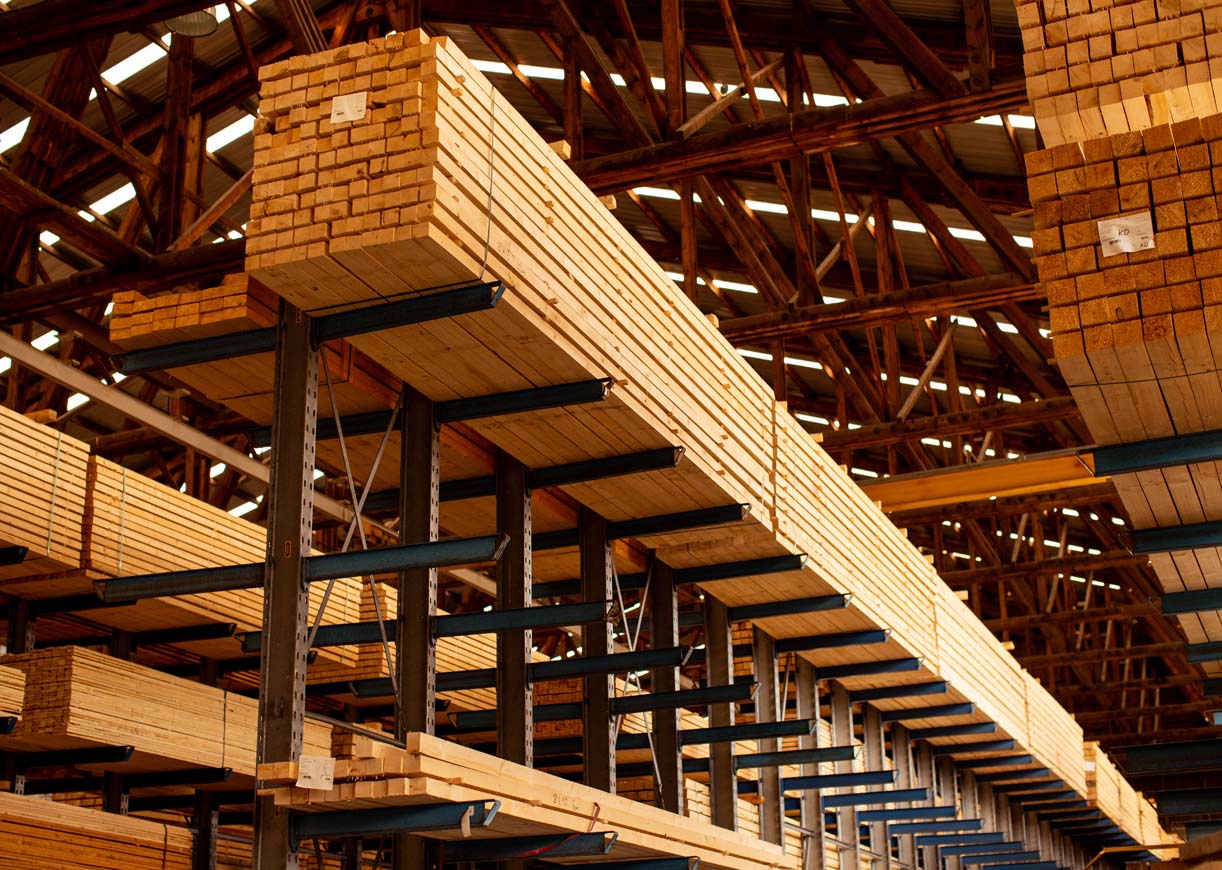
Timber warehouse with stacked lumber planks - representative of Danish lumber industry operations
The federation's core focus areas in recent years have encompassed several critical dimensions of the timber trade. First and foremost is the fight against illegal and unsustainable forestry, which remains one of the most significant challenges facing the global wood industry. The federation actively supports the European Union Timber Regulation (EUTR) and the more recent EU Deforestation Regulation (EUDR), both of which aim to block trade in illegally harvested wood and ensure that timber entering the EU market comes from legal and sustainable sources. The federation also engages in certification initiatives, promotes its members' Code of Conduct for responsible sourcing, and works on CE marking of wood-based construction products. Additionally, environmental matters, public procurement policies for wood, and FLEGT (Forest Law Enforcement, Governance and Trade) initiatives are all areas where the federation maintains active involvement and advocacy.
As an organization and industry body, the Danish Timber Trade Federation firmly believes that wood has a compelling story to tell in the modern marketplace. Wood is the world's most environmentally friendly and renewable raw material, and the federation actively works to promote this message. Through its role as secretariat for the Danish Wood Initiative (trae.dk), the federation aims to raise awareness of timber's potential and grow its use among architects, builders, and consumers. At the European level, the federation's membership in the European Timber Trade Federation (ETTF) is of great importance, as ETTF works to ensure a level playing field across EU member states for timber businesses and raises awareness of timber regulations across the continent.
Complete Member Directory - 31 Lumber Companies
The following table presents the complete directory of all 31 member companies of the Danish Timber Trade Federation. These firms represent the full spectrum of the Danish lumber industry, from large-scale timber importers handling softwood, hardwood, and tropical species to specialized plywood and veneer merchants. Each company has been verified as a member in good standing of the federation and is committed to the organization's Code of Conduct for responsible and legal timber sourcing. Contact information and website links are provided where available, enabling direct outreach for business inquiries, partnership opportunities, or supply chain due diligence verification.
| No | Company Name | Business Type | City / Location |
|---|---|---|---|
| 1 | A. Rindom A/S | Timber Importer | Copenhagen |
| 2 | Bergsten Timber A/S | Timber Importer | Birkerod |
| 3 | Copenhagen Hardwood ApS | Hardwood Importer | Copenhagen |
| 4 | DLH Danmark A/S | Timber & Plywood Importer | Kolding |
| 5 | Einar Risor Finerhandel A/S | Veneer Trader | Risor |
| 6 | Froslev Trae A/S | Timber Importer | Padborg |
| 7 | Global Timber A/S | Timber Importer | Horsens |
| 8 | Gunnar T. Strom Danmark A/S | Timber Importer | Hobro |
| 9 | Hardwood Partners ApS | Hardwood Importer | Haslev |
| 10 | Hem Denmark A/S | Timber Importer | Herning |
| 11 | HH Trae & Finer ApS | Timber & Veneer Trader | Hellerup |
| 12 | Hjalmar Wennerth A/S | Timber Importer | Copenhagen |
| 13 | HardtTraelasten P/S | Hardwood Trader | Denmark |
| 14 | Keflico A/S | Timber & Panel Importer | Kolding |
| 15 | Krydsfiner-Handelen A/S | Plywood Trader | Copenhagen |
| 16 | Madera ApS | Hardwood Importer | Copenhagen |
| 17 | NPI A/S | Timber Importer | Hvide Sande |
| 18 | Protrae A/S | Timber Importer | Silkeborg |
| 19 | Riisfort A/S | Timber Importer | Copenhagen |
| 20 | Rigawood | Timber Trader | Riga / Denmark |
| 21 | Sommer-Savex A/S | Timber Importer | Vamdrup |
| 22 | Stora Enso Trae A/S | Timber & Panel Importer | Copenhagen |
| 23 | Sodra Timber A/S | Timber Importer | Copenhagen |
| 24 | Timberlink ApS | Timber Importer | Denmark |
| 25 | Timply A/S | Timber Trader | Denmark |
| 26 | WISA Plywood ApS | Plywood Importer | Copenhagen |
| 27 | Vandecasteele Houtimport | Timber Importer | Belgium / Denmark |
| 28 | Vica Wood ApS | Timber Importer | Copenhagen |
| 29 | Vida Wood Danmark | Timber Importer | Denmark |
| 30 | Wood House Denmark A/S | Timber Trader | Denmark |
| 31 | WoodyWood ApS | Timber Trader | Denmark |
The member directory reveals a diverse and well-distributed network of lumber companies across Denmark. Copenhagen and its surrounding metropolitan area host the largest concentration of member firms, reflecting the capital region's role as Denmark's primary commercial and logistics hub. Several companies are also located in Jutland, particularly in cities like Kolding, Horsens, Silkeborg, and Herning, which are strategically positioned near Denmark's major ports and transportation corridors. This geographic distribution ensures that timber supplies are readily accessible throughout the country, supporting Denmark's robust construction, furniture, and manufacturing sectors.
Hardwood Importers in Denmark
Hardwood importers represent a vital segment of the Danish lumber industry, supplying premium wood species that are essential for furniture manufacturing, interior design, flooring, and specialty applications. Among the federation's members, several companies specialize specifically in hardwood imports, including Copenhagen Hardwood ApS, Hardwood Partners ApS, Madera ApS, and HardtTraelasten P/S. These firms source hardwood from a variety of global origins, including tropical species from Africa, South America, and Southeast Asia, as well as temperate hardwoods from North America and Europe.
Copenhagen Hardwood ApS, based in the capital, has established itself as one of Denmark's most recognized hardwood importers, offering a comprehensive range of both tropical and temperate species. Hardwood Partners ApS, operating through its sawmill.dk platform, focuses on providing hardwood solutions with an emphasis on sustainability and certified sourcing. Madera ApS serves the Danish market through its webshop platform, making hardwood products accessible to both professional and retail customers. HardtTraelasten P/S, as a partnership structure, represents a specialized hardwood trading operation with deep roots in the Danish market.
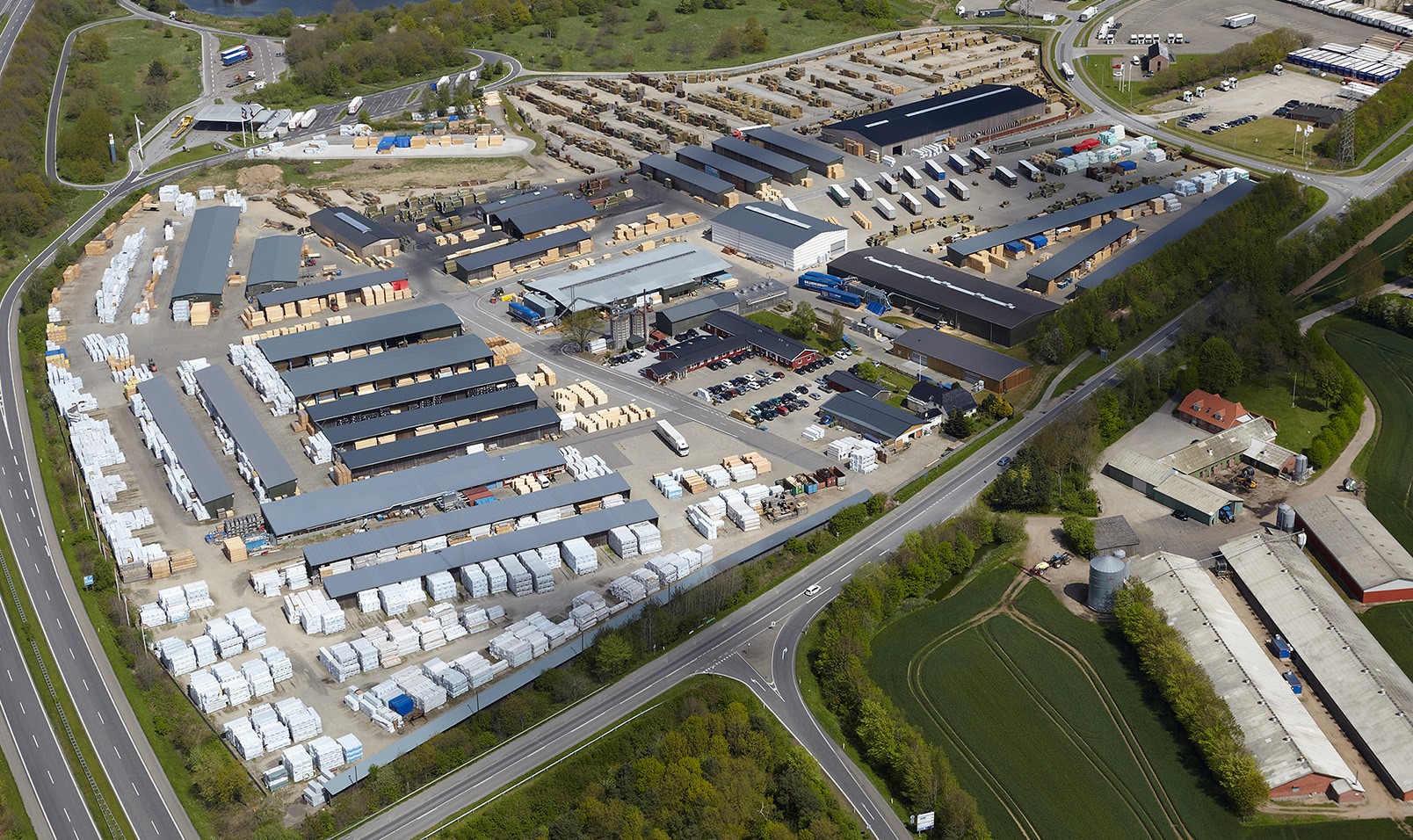
Aerial view of a large timber warehouse complex - typical infrastructure for Danish lumber importers
The Danish hardwood market is characterized by a strong emphasis on sustainability and legality verification. All hardwood importers who are members of the Danish Timber Trade Federation are bound by the organization's Code of Conduct, which commits them to sourcing only legal and preferably sustainable timber. This commitment is particularly important for tropical hardwood species, which have historically been associated with deforestation and illegal logging concerns. The federation provides guidance on due diligence requirements under the EU Timber Regulation and the newer EU Deforestation Regulation, helping its members navigate the complex compliance landscape. Additionally, the federation publishes regular information bulletins and hosts seminars on topics such as timber certification, FSC and PEFC systems, and best practices for supply chain verification.
Plywood and Panel Traders
Plywood and wood-based panel products constitute another important category within the Danish lumber trade. Among the federation's members, Krydsfiner-Handelen A/S and WISA Plywood ApS are the most prominent specialists in this segment. Krydsfiner-Handelen A/S, whose name literally translates to "The Plywood Trade," is one of Denmark's oldest and most established plywood merchants, with decades of experience in sourcing and distributing plywood products from leading global producers. The company handles a wide range of plywood types, including softwood plywood, hardwood plywood, birch plywood, and specialty panels for marine, aviation, and construction applications.
WISA Plywood ApS represents the Danish operations of UPM's WISA plywood brand, one of Europe's largest plywood manufacturers. WISA plywood products are widely used in the Danish construction industry for concrete formwork, structural panels, and general building applications. The company's presence in the federation underscores the importance of vertically integrated wood industry players who combine manufacturing with distribution. Beyond these two specialists, several general timber importers among the federation's members also carry plywood and panel products as part of their broader product portfolios. Companies such as DLH Danmark A/S, Keflico A/S, and Stora Enso Trae A/S all offer significant plywood and panel product ranges alongside their timber offerings, providing Danish buyers with multiple sourcing options for these essential building materials.
Veneer Merchants
Veneer trading represents a niche but highly valuable segment of the Danish lumber industry. Veneers are thin slices of premium wood used as decorative surface coverings in furniture, cabinetry, interior paneling, and luxury applications. The production and trading of veneers requires specialized knowledge of wood species, slicing techniques, and quality grading, making it a distinct discipline within the broader timber trade. Among the Danish Timber Trade Federation's members, Einar Risor Finerhandel A/S and HH Trae & Finer ApS are the primary veneer specialists.
Einar Risor Finerhandel A/S, based in the historic coastal town of Risor on Norway's border, has built its reputation on decades of experience in the veneer trade. The company's name, which includes "Finerhandel" (veneer trade), reflects its core specialization. Risor itself has a rich maritime and timber trading history, and Einar Risor Finerhandel A/S continues this tradition by connecting Danish furniture and interior manufacturers with premium veneer supplies from around the world. HH Trae & Finer ApS, based in Hellerup near Copenhagen, combines timber trading with veneer dealing, offering customers a comprehensive range of both solid wood and veneer products. The company's dual focus on timber and veneer allows it to serve customers who require both structural and decorative wood products, providing a convenient single-source solution for furniture makers and interior contractors.
Board of Directors
The Danish Timber Trade Federation is governed by a board of directors composed of senior executives from member companies. The board sets the strategic direction for the organization, oversees its advocacy efforts, and ensures that the federation's activities align with the interests of its membership. The current board brings together experience from across the spectrum of the Danish timber industry, from hardwood and plywood trading to softwood importing and industrial wood products.
| Name | Position | Company |
|---|---|---|
| Morten Bergsten | Chairman | Bergsten Timber |
| Camilla Hyldgaard Thomsen | Board Member | Keflico |
| Morten Lind | Board Member | Wennerth Wood |
| Bjarne Risor | Board Member | Einar Risor Finerhandel A/S |
| Jesper Harck | Board Member | Stora Enso Danmark |
| Tonny Dalsgaard | Board Member | Dalhoff Larsen & Horneman A/S |
The board is chaired by Morten Bergsten of Bergsten Timber A/S, one of Denmark's leading timber importing companies. Under his leadership, the federation has strengthened its focus on sustainability compliance, particularly in light of the new EU Deforestation Regulation which came into effect in 2023. The diverse composition of the board, representing hardwood importers, plywood distributors, softwood traders, and industrial wood product companies, ensures that the federation's advocacy and policy positions reflect the full breadth of its membership's interests. The board meets regularly to discuss industry developments, regulatory changes, market trends, and strategic initiatives, and its decisions guide the federation's day-to-day operations carried out by the secretariat in Naerum.
Sustainability and Legal Timber Sourcing
Sustainability and legality are foundational principles of the Danish Timber Trade Federation and its member companies. The federation's Code of Conduct explicitly requires all members to source only legal and preferably sustainable timber, setting a high ethical standard for the Danish lumber industry. This commitment goes beyond mere regulatory compliance; it reflects a deep understanding that the long-term viability of the timber trade depends on the health and sustainability of the world's forests. As the federation states, "Timber is our members' business and livelihood and, with them, we have a commercial interest in ensuring the long-term future of the world's forests through sustainable management."
The regulatory landscape for timber imports into the European Union has become increasingly stringent in recent years. The EU Timber Regulation (EUTR), which has been in force since 2013, prohibits the placing of illegally harvested timber on the EU market and requires operators to exercise due diligence in their supply chains. The more recent EU Deforestation Regulation (EUDR), which entered into application in 2024, goes further by requiring operators to ensure that commodities, including wood, placed on the EU market are deforestation-free and legally produced in their country of origin. The Danish Timber Trade Federation has been proactive in preparing its members for these regulatory requirements, providing guidance documents, training sessions, and due diligence tools to facilitate compliance. The federation also publishes information bulletins from both the European Timber Trade Federation (ETTF) and the Danish Environmental Protection Agency (Miljoestyrelsen) to keep members informed of regulatory developments and best practices.
Certification plays an important role in the federation's sustainability framework. The most widely recognized certification systems in the timber industry are the Forest Stewardship Council (FSC) and the Programme for the Endorsement of Forest Certification (PEFC). These systems provide independent verification that timber comes from responsibly managed forests, and many of the federation's member companies actively seek certified timber to meet customer demand and regulatory requirements. The federation supports certification as a tool for demonstrating sustainability but also recognizes that certification alone is not sufficient and must be complemented by robust due diligence systems and supply chain transparency.
Denmark's Role in European Timber Trade
Denmark occupies a strategically important position in the European timber trade, serving as both a significant end market and a transit point for wood products flowing into the broader Scandinavian and European regions. Despite being a small country in terms of population, Denmark's timber consumption is substantial, driven by a strong construction sector, a world-renowned furniture design industry, and an active packaging and manufacturing base. The country's well-developed port infrastructure, efficient logistics networks, and central geographic location within Northern Europe make it an attractive entry point for timber imports from all major producing regions around the world.
The Danish timber market is characterized by its diversity of supply sources. Member companies of the Danish Timber Trade Federation import timber from an exceptionally wide range of origins, including the Baltic states (Latvia, Estonia, Lithuania), the Nordic countries (Sweden, Finland), Russia, Central and Eastern Europe, North America, South America, Africa, and Southeast Asia. This diversity of supply is both a strength and a necessity: it provides resilience against supply disruptions from any single origin while also reflecting the varied demands of Danish end-users for different species, qualities, and product types. The federation's statistics show that softwood (primarily spruce, pine, and fir) constitutes the largest volume of imports, followed by hardwood, plywood, and veneer products.
Denmark's membership in the European Union and its participation in the EU's single market framework have significant implications for the timber trade. As an EU member state, Denmark benefits from tariff-free access to timber supplies from other EU countries and must comply with EU-wide regulations such as the EUTR and EUDR. At the same time, Denmark's traditionally strong trade links with non-EU countries, particularly in the developing world, mean that Danish timber importers have extensive experience in navigating the complexities of international timber trade, including customs procedures, phytosanitary requirements, and sustainability documentation. The Danish Timber Trade Federation plays a crucial role in supporting its members through this regulatory landscape, providing guidance, advocacy, and a platform for collective engagement with authorities at both national and European levels.
Frequently Asked Questions
What is the Danish Timber Trade Federation?
The Danish Timber Trade Federation (Dansk Traeforening) is the industry association representing Denmark's leading timber importing and trading companies. Founded in 1893, the organization currently represents 31 member companies and serves as their collective voice in negotiations with authorities and organizations. The federation's headquarters are located in Naerum, north of Copenhagen, and it is led by Director Jakob Rygg Klaumann. The organization was formed in its current structure in 1991 through the merger of two predecessor associations.
How many lumber companies are members of the Danish Timber Trade Federation?
The Danish Timber Trade Federation currently represents 31 member companies. These members include timber importers, agents, and timber traders who handle significant imports of timber into Denmark from worldwide origins. The complete directory of all member companies, with their websites and contact information, is available on the federation's website at dktimber.dk under the "Medlemmer af Dansk Traeforening" section.
What types of companies are included in the Danish lumber industry?
The Danish lumber industry encompasses several types of companies: (1) Timber importers who bring softwood, hardwood, and tropical timber into Denmark from global origins; (2) Hardwood specialists who focus on premium wood species for furniture, flooring, and decorative applications; (3) Plywood and panel traders who distribute engineered wood products for construction and industrial uses; (4) Veneer merchants who deal in thin decorative wood slices for luxury applications; and (5) General timber traders and agents who operate across multiple product categories. All member types are represented among the federation's 31 member companies.
What sustainability commitments do Danish lumber companies make?
All member companies of the Danish Timber Trade Federation are bound by the organization's Code of Conduct, which requires them to source only legal and preferably sustainable timber. Members must comply with the EU Timber Regulation (EUTR), which prohibits trade in illegally harvested timber, and the newer EU Deforestation Regulation (EUDR), which requires timber to be deforestation-free. Many members also seek FSC and PEFC certified timber to demonstrate their sustainability credentials. The federation provides guidance, training, and due diligence tools to help members meet these requirements.
How can I contact a Danish lumber company for business inquiries?
You can reach Danish lumber companies through several channels: (1) Visit the company's website directly - website links are provided in the member directory table above; (2) Contact the Danish Timber Trade Federation at +45 45 87 54 00 or dktimber@dktimber.dk for general inquiries or member referrals; (3) Visit the federation's website at dktimber.dk/english/ for additional information and resources. The federation's office is located at Egebaekvej 98, 2850 Naerum, Denmark.
What is the history of the Danish Timber Trade Federation?
The Danish Timber Trade Federation has its origins in 1893, making it one of Denmark's oldest industry associations. The current organization was formed in 1991 through the merger of two predecessor organizations: "Dansk Traehandlerforening" (Danish Timber Merchants Association) and "Foreningen Danske Traelastimportorer" (Association of Danish Timber Importers). These two organizations united under the name Dansk Traeforening, or in English, the Danish Timber Trade Federation, to provide a stronger, unified voice for the Danish timber trade sector.
What is the EU Timber Regulation and how does it affect Danish lumber companies?
The EU Timber Regulation (EUTR), in force since 2013, is a key piece of European legislation that prohibits the placing of illegally harvested timber and timber products on the EU market. It requires operators (those who first place timber on the EU market) to exercise due diligence through a Due Diligence System (DDS) that includes information gathering, risk assessment, and risk mitigation steps. The more recent EU Deforestation Regulation (EUDR), effective from 2024, extends these requirements by mandating that wood products be deforestation-free and legally produced. Danish Timber Trade Federation members must comply with both regulations, and the federation provides extensive guidance and support for compliance.
Yorumlar - Yorum Yaz